Atradius Atrium
Sie erhalten direkten Zugriff auf Ihre Vertragsinformationen, Tools zur Beantragung von Kreditlimits und Einblicke.

Beliebte Suchbegriffe
 Schweiz
 Australien
 Belgien
 Brazil
 Bulgarien
 China
China
 Dänemark
 Deutschland
 Finnland
 Frankreich
 Griechenland
 Gruppe
 Hongkong
 Indien
 Irland
 Italien
 Japan
Japan
 Kanada
 Litauen
 Mexiko
 Neuseeland
 Niederlande
 Norwegen
 Österreich
 Polen
Polen
 Portugal
 Rumänien
 Schweden
Schweiz
Schweden
Schweiz
 Singapur
 Slowakei
 Slowenien
 Spain
Spain
 Tschechische Republik
 Türkei
 Ungarn
 Vereinigte Arabische Emirate
 Vereinigtes Königreich
 Vereinigte Staaten
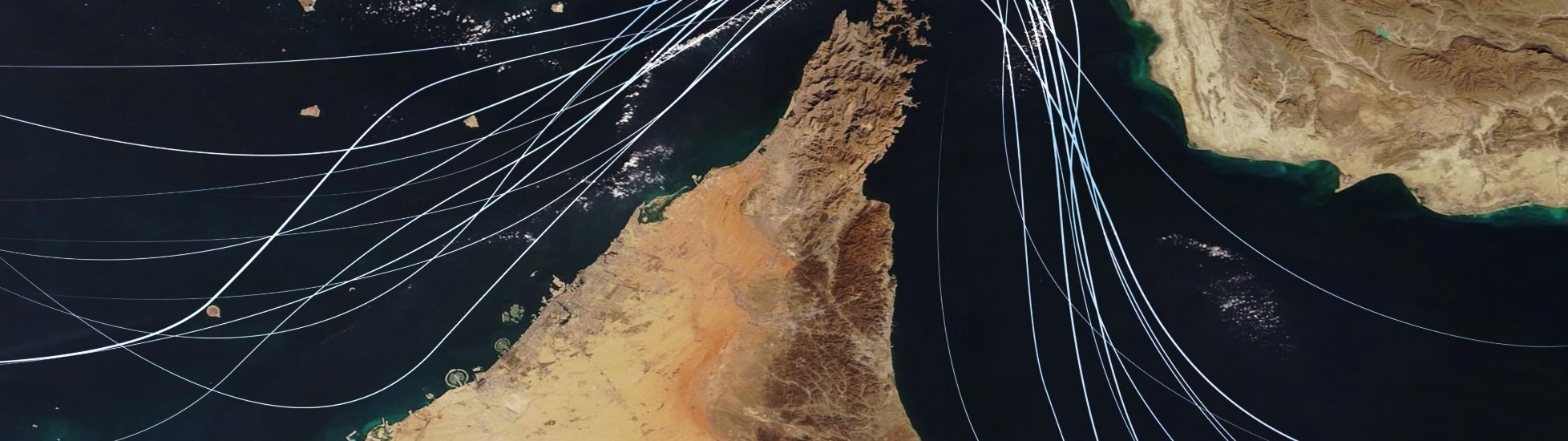
On 28 February 2026, a wave of US-led strikes inside Iran marked a decisive shift in the dynamics of the Middle East. Intended to neutralise a strategic threat, the operation instead triggered a chain of events that has reshaped global trade flows. Within days, Iran had turned the Strait of Hormuz, one of the world’s most critical trade arteries, into a pressure point. The immediate impact was a sharp rise in energy prices and widespread disruption across shipping.
Recent developments suggest the conflict may be entering a fragile de-escalation phase, with a preliminary agreement in place and a shift from military confrontation to complex negotiations, although key risks remain. In our baseline scenario, we assume the preliminary deal leads to a gradual resumption of transit through the Strait of Hormuz. However, if the crisis persists, it could have a more sustained impact on inflation and lead to a more pronounced global economic slowdown.
Global growth is expected to slow to 2.4% in 2026, falling below its post-pandemic average. Growth is also diverging, with advanced economies slowing to around 1.5%, while emerging markets are projected to expand by 3.7%, remaining more resilient but still below historical norms. This deceleration is largely driven by higher energy prices, shipping disruptions and elevated uncertainty. Commodity-importing economies with pre-existing vulnerabilities are particularly exposed to these pressures.
The sharp reduction in traffic has pushed up energy costs and constrained supply chains, weighing on both consumption and production worldwide. At the same time, global trade is losing momentum after a strong 2025.
According to Theo Smid, Senior Economist at Atradius, “The Strait of Hormuz plays a central role in this dynamic. As one of the world’s most critical energy corridors, it carries around a quarter of global oil trade and a fifth of LNG flows. Beyond oil and gas, the impact extends to fertilisers, refined fuels and industrial metals such as aluminium. These are critical inputs for multiple industries, amplifying the economic impact. The sharp reduction in traffic has pushed up energy costs and constrained supply chains, weighing on both consumption and production worldwide. At the same time, global trade is losing momentum after a strong 2025. Higher costs, persistent policy uncertainty and cooling demand are all weighing on the outlook.”
The conflict has triggered a renewed increase in inflation, with global levels projected to rise to 4.8% in 2026. Higher energy prices are the main driver, reinforced by second-round effects on manufacturing and transport. However, this inflationary shock is expected to be more contained than in 2022. Slower demand, looser labour markets and more limited supply chain disruption are all acting as mitigating factors.
The result is a more complex monetary environment. Recent moves such as the ECB raising interest rates for the first time in three years to combat inflation linked to the war in the Middle East underline this shift. Central banks are likely to remain cautious, delaying rate cuts and potentially tightening further if inflation proves persistent. Inflation could decline next year, providing central banks with more room to cut interest rates. However, uncertainty remains high, particularly if the Middle East crisis persists. In that scenario, energy prices would stay elevated for longer, triggering central banks to raise policy rates to anchor inflation expectations.
According to Roeland Punt, CEO of Atradius Middle East, “From a Middle East perspective, volatility is a given. What matters is how it is absorbed and managed. While trade disruption is clearly feeding through to costs, liquidity and payment behaviour, the region is responding with discipline, resilience and resourcefulness. We are seeing more selective and data led decision making, with businesses prioritising continuity and financial strength over pure growth. This is reinforcing the region’s ability to navigate uncertainty while maintaining its position as a stable commercial hub.”
From a Middle East perspective, volatility is a given. While trade disruption is clearly feeding through to costs, liquidity and payment behaviour, the region is responding with discipline, resilience and resourcefulness.
The economic impact on Gulf countries is significant in the short term, with the region now expected to contract in 2026 compared to earlier expectations of strong growth. However, underlying fundamentals remain strong. Most countries benefit from low public debt, substantial fiscal buffers and well-capitalised financial systems.
Crucially, governments are actively strengthening resilience. Investments in infrastructure, alternative trade routes and strategic capacity are accelerating. These efforts aim to reduce dependence on vulnerable chokepoints and strengthen long-term stability.
According to Niels de Hoog, Senior Economist at Atradius, “The Middle East crisis is reshaping the regional landscape. The decision by the UAE to leave OPEC reflects a broader shift towards greater national autonomy in production strategy, signalling a move away from traditional coordination mechanisms and towards more competitive dynamics within the region. This evolution is not isolated but part of a wider repositioning in which countries are seeking more control over their economic and strategic direction. Gulf countries are balancing geopolitical risks carefully. Their priority remains to preserve their position as stable economic hubs, avoiding escalation while strengthening defensive capabilities and economic independence.”
Gulf countries are balancing geopolitical risks carefully. Their priority remains to preserve their position as stable economic hubs, avoiding escalation while strengthening defensive capabilities and economic independence.
Investment in digital infrastructure continues across the region, even as geopolitical tensions lead to more cautious decision-making and tighter risk considerations. This does not reverse the region’s ambitions. The Middle East retains strong structural advantages, including access to low-cost energy, capital and government support. Rather than slowing momentum, the current environment is reshaping how and where investments are deployed:
“Before the conflict, countries such as the UAE, Saudi Arabia and Qatar were competing intensely to position themselves as global AI hubs, investing heavily in digital infrastructure and attracting major tech players. However, recent attacks on data centres have exposed a new layer of vulnerability. These facilities are no longer just commercial assets; they have become critical infrastructure. As a result, geopolitical risk is now playing a much more prominent role in investment decisions,” says de Hoog.
Before the conflict, countries such as the UAE, Saudi Arabia and Qatar were competing intensely to position themselves as global AI hubs, investing heavily in digital infrastructure and attracting major tech players.
The crisis has also exposed vulnerabilities in global trade. The disruption to shipping routes, affecting around 2,000 vessels, has highlighted the fragility of key supply chains. In response, companies and governments are not only addressing immediate bottlenecks but are also accelerating efforts to diversify routes and redesign logistics networks. What emerges is a clear structural trend in which energy policy, geopolitics and supply chains are aligning around resilience, flexibility and reduced dependence on single points of failure.
Against this backdrop, global corporate insolvencies are expected to rise by 3% in 2026, reflecting persistent pressure from higher costs, tighter financing conditions, weaker demand and compressed margins. A decline is projected for 2027, but this hinges on a normalisation of energy markets and some easing of geopolitical tensions. For now, the environment is best characterised as one of stabilisation rather than recovery, making close monitoring of each customer’s financial position essential.
In our baseline scenario, a gradual de-escalation would support lower energy prices and a modest recovery in economic activity from 2027. However, downside risks remain significant, as a prolonged disruption could lead to higher inflation, tighter financial conditions and a more pronounced global slowdown.
Beyond the immediate cycle, current developments are also accelerating structural shifts, including the diversification of supply chains, changing dynamics in energy geopolitics and a stronger focus on resilience in investment decisions. For businesses, the implication is clear: resilience is no longer optional but a central pillar of strategy in a world where geopolitical risk is more persistent and systemic.
To explore how to strengthen your own credit risk strategy, get in touch with us and see how we can help you stay ahead.


